Is higher luminous efficacy always more energy-efficient?
Is higher luminous efficacy always more energy-efficient?
This article originally published on www.lrmled.com
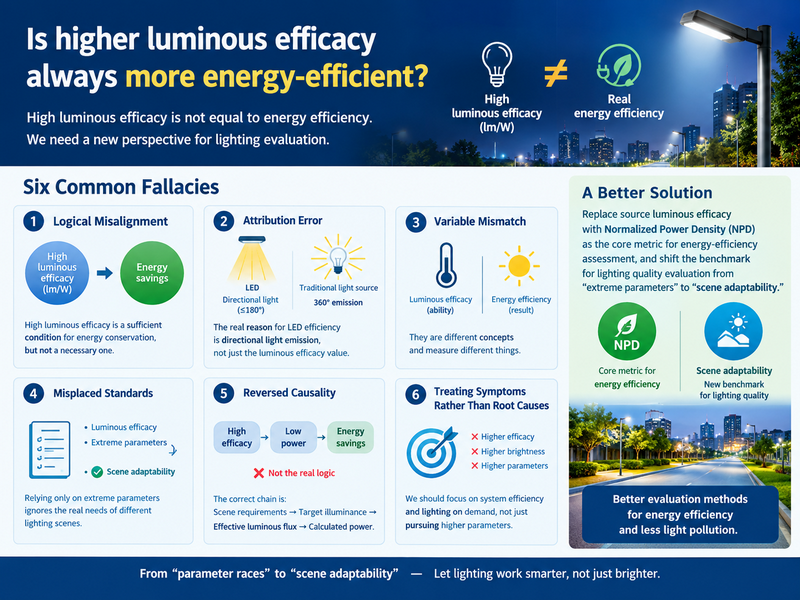
Traditional assessments of lighting energy efficiency have relied too heavily on the "luminous efficacy of the light source" (lm/W) metric. This has led to resource waste, inverted energy-efficiency outcomes, and rampant light pollution—all driven by a fixation on luminous efficacy. Drawing on the theory of "adaptive luminous efficacy," this paper systematically analyzes six conceptual fallacies underlying the industry consensus that "higher luminous efficacy equals greater energy efficiency": logical misalignment, attribution errors, variable mismatch, misplaced standards, reversed causality, and treating symptoms rather than root causes. By integrating cutting-edge international metrics and practices for light pollution control, the paper proposes replacing source luminous efficacy with "Normalized Power Density (NPD)" as the core metric for energy-efficiency assessment, and shifting the benchmark for lighting quality evaluation from "extreme parameters" to "scene adaptability." This provides both a theoretical basis and a practical pathway for evaluating lighting energy efficiency and mitigating light pollution.
In the lighting industry, the idea that "higher luminous efficacy equals greater energy efficiency" has become an almost unquestionable "axiom." Tender documents list it as a mandatory requirement, companies use it as a key selling point, and designers treat it as the primary criterion for product selection. High luminous efficacy is synonymous with energy efficiency, fueling a fierce "race for efficacy" across the sector.
Yet, this seemingly common-sense proposition is actually the single greatest conceptual misconception in the field of lighting energy efficiency.
High luminous efficacy (lm/W) is merely a parameter indicating how efficiently a light source converts electrical energy into light energy; it is neither equivalent to system energy efficiency nor to actual energy savings. Treating high luminous efficacy as a "universal cure-all" for energy efficiency reflects a fundamental misunderstanding of lighting systems. The theory of "adaptive luminous efficacy" challenges this ingrained mindset, positing that luminous efficacy is a dynamic variable contingent upon the specific scene being illuminated.
This paper systematically demonstrates—across six dimensions—that the notion "higher luminous efficacy equals greater energy efficiency" is a fallacy. Assessments of lighting energy efficiency must shift from "component efficiency" to "system effective illuminance," and evaluations of lighting quality must move away from "parameter races" toward "scene adaptability."
*Logical Misalignment: A Sufficient Condition Is Not a Necessary Condition
The first fallacy in the idea that "higher luminous efficacy equals greater energy efficiency" lies in a fundamental logical misalignment.
High luminous efficacy refers to the luminous flux produced per watt of power (lm/W); it describes a capability—specifically, how much light can be emitted per unit of power. However, the goal of energy conservation is the result itself: consuming the least amount of electrical energy while still meeting visual requirements.
The relationship between the two is clear: high luminous efficacy is a sufficient condition for energy conservation (high efficacy → potential for energy savings), but not a necessary one (energy conservation ≠ requiring high efficacy). More importantly, in specific application scenarios, high luminous efficacy can actually lead to inefficiency. When a light source’s output far exceeds the scenario's actual needs, the excess luminous flux must be curtailed—for instance, by reducing power or adding light-blocking accessories—and this process inherently entails efficiency losses. The theoretical gains from high efficacy are largely negated by the need to suppress excess light; instead of saving energy, this creates more wasted light output.
Inferring fixture energy efficiency directly from high luminous efficacy is a logical fallacy that mistakes the effect for the cause. The logical chain for energy-efficient lighting should be "scenario requirements → target illuminance → effective luminous flux → calculated power," rather than "high efficacy → low power → energy savings." The core of energy conservation is "lighting on demand," not "unlimited supply."
*Attribution Error: The essence of LED energy efficiency lies in "directional light emission," not the "luminous efficacy value."
The second fallacy regarding the idea that "higher luminous efficacy equals greater energy savings" stems from a misattribution of the reasons behind LED efficiency.
While it is indisputable that LEDs are more energy-efficient than traditional light sources when luminous efficacy is equal, there is a significant misunderstanding regarding *why* this is the case. The fundamental reason LEDs outperform traditional sources (such as metal-halide or fluorescent lamps) is their directional emission characteristic: LEDs typically emit light within an angle of ≤180°, whereas traditional sources emit light in a full 360° pattern. Because LEDs emit directional light, the fixture utilization factor can reach 0.8–0.9, compared to only 0.4–0.5 for fixtures using other light sources.
With traditional 360° light sources, at least 30% to 40% of the luminous flux must be redirected toward the target area via the optical chamber; frequent reflections result in massive losses due to absorption and scattering. In contrast, the directional nature of LEDs ensures a far higher utilization rate of luminous flux. Consequently, even if the luminous efficacy of the light sources is identical, using LEDs results in significant energy savings compared to traditional sources. The conclusion is self-evident: the real hero behind LED energy efficiency is the "Coefficient of Utilization" (CU), not the nominal luminous efficacy value cited from laboratory tests. While LEDs are indeed more energy-efficient when luminous efficacy is equal, the reverse is not necessarily true: high luminous efficacy does not automatically guarantee energy savings. Attributing the energy-saving advantage of LEDs solely to "high luminous efficacy" is a classic case of confusing cause and effect. In actual application scenarios, factors such as the luminaire's light distribution design, installation method, and the characteristics of the illuminated surface collectively determine the power requirement; luminous efficacy is merely one parameter among them, and not the decisive one.
*Variable Mismatch: Luminous efficacy is a dependent variable of the scenario, not a constant
The third fallacy in the notion that "higher luminous efficacy equals greater energy savings" lies in mistaking static laboratory parameters for universal constants.
The "nominal luminous efficacy" measured in a laboratory represents a static peak value obtained at 25°C and rated current. In real-world use, however, luminous efficacy fluctuates drastically depending on the scenario: a rise in junction temperature (Tj) causes a sharp drop in efficacy; under PWM or analog dimming, efficacy changes non-linearly with output power; the addition of optical accessories—such as diffusers, lenses, or anti-glare louvers—can result in efficacy losses of 15% to 40%; efficacy varies significantly across different color temperatures and color rendering indices; and system-level factors, such as power supply efficiency and thermal management, also profoundly impact actual efficacy.
Whether through physical light control (lenses, reflectors, baffles) or intelligent dimming (light sensors, timers, occupancy sensors), luminous efficacy shifts according to the scenario. It is a dynamic variable dependent on the illuminated environment; the scenario acts as the independent variable, while luminous efficacy is the dependent variable. Attempting to apply a single laboratory figure to every scenario is futile—akin to the proverb of "marking the boat to find the sword."
The core of the "adapted luminous efficacy" theory is the recognition that the benchmark for evaluating lighting energy efficiency should be "scenario-based luminous efficacy." This measures the energy-saving value of a light source in a real-world setting by calculating the product of the source's luminous efficacy and the utilization rate of effective luminous flux, rather than relying on the device's efficacy measured in isolation within a laboratory.
*Standard Misalignment: Power density should be the sole benchmark for assessing lighting energy efficiency
The fourth fallacy in the idea that "higher luminous efficacy equals greater energy savings" lies in a fundamental misalignment regarding what is being assessed.
Luminous efficacy assessments focus on the light source (the device itself), whereas energy efficiency assessments focus on the system (the installation as a whole). Treating light source parameters as the primary metric for system energy efficiency is akin to evaluating a car's fuel economy based on engine "thermal efficiency" rather than actual "fuel consumption per 100 kilometers"—it is both absurd and unscientific.
The ultimate criterion for assessing lighting energy efficiency should be: achieving the minimum required power density for a specific scenario while meeting quality requirements such as target illuminance, uniformity, and glare limits. When selecting a light source, the sole basis for judgment is whether it meets the scenario's lighting needs using the lowest possible system power. The minimum achievable power density is the only true yardstick for measuring energy efficiency.
Specifically, Normalized Power Density (NPD) should be adopted as the core assessment metric. Its formula is:
NPD = LPD / Eav = (ΣP / S) / Eav
Where ΣP is the total installed lighting power (W), S is the illuminated area (m²), and Eav is the average maintained illuminance of the area (lx); the unit is typically expressed as W/(m²·100 lx).
NPD assesses not "how much light a source produces," but rather "how much effective illuminance is obtained per watt of electricity"—this is the very essence of lighting energy efficiency. By normalizing illuminance differences, it allows for fair comparisons across different scenarios using a single standard; it is a metric that is more scientific, equitable, and aligned with the true nature of energy efficiency than mere luminous efficacy.
*Confusing Cause and Effect: High Luminous Efficacy Drives Light Pollution Rather Than Curing It*
The fifth—and perhaps most overlooked—fallacy in the notion that "higher luminous efficacy equals greater energy efficiency" is that it inverts cause and effect, obscuring the true origins of light pollution.
What actually causes light pollution? It is not that low luminous efficacy necessitates an excessive number of fixtures; quite the opposite. The problem arises from mistakenly viewing high luminous efficacy as a magic bullet for energy savings—blindly pushing for higher efficacy and piling on lumens without regard for actual scenario requirements—which leads to a proliferation of stray, wasted light. In roadway lighting, the excessive pursuit of high-efficacy fixtures—without matching them with precise light distribution—results in vast amounts of light spilling beyond the road surface toward the sky and surrounding buildings. In building façade lighting, the blind accumulation of high-power floodlights to achieve a "bright effect" causes light to shine directly into the sky or intrude into residents' windows. Meanwhile, high-brightness LED displays and lightboxes used for advertising run continuously at night, creating persistent curtains of light across the urban skyline.
The logic behind this "worship of high efficacy" is as follows: higher efficacy means greater brightness for the same power input; greater brightness is inherently better; and greater brightness equates to "energy savings." Within this chain of reasoning, energy conservation is distorted into a mere piling on of brightness, and quality is reduced to a competition over technical specifications; light pollution is the inevitable outcome of this fallacy.
If the direction is wrong, moving faster only takes you further off course. Taking pride in high efficacy and equating high brightness with beauty are precisely the technical root causes of escalating light pollution.
*The Fundamental Solution: From "Generating Light Pollution" to "Controlling Light Limits"*
Identifying the primary cause of light pollution reveals the method for addressing it.
Current approaches to controlling light pollution largely focus on treating symptoms: regulating installation angles to minimize direct upward light, using timers to switch off certain lights late at night, and employing dimming systems to adjust brightness based on pedestrian and vehicular traffic. While effective, these measures are reactive—attempting to constrain the light only after it has already been emitted.
The fundamental solution lies in evaluating lighting quality based on "appropriate efficacy" and establishing a closed-loop logic at the source: "generating sufficient light, generating quality light, and utilizing light effectively."
"Generating sufficient light" means directing light precisely to the target area to minimize wasteful spillover; "generating quality light" involves selecting the right spectrum, color temperature, and color rendering properties rather than blindly chasing high lumen counts; and "utilizing light effectively" means dynamically adjusting output based on the scenario to achieve "lighting on demand" rather than "full-capacity supply." Together, these three elements form a complete logical loop: first determining "how much light is needed," then deciding "how much light to emit," and finally controlling "how that light is used." The level of efficacy is merely a technical parameter in the intermediate stage—not the starting point, and certainly not the ultimate goal. High luminous efficacy and light pollution are two sides of the same coin. High efficacy itself is not the problem; the issue lies in the disregard for specific scene requirements caused by an obsession with efficacy metrics alone. By properly matching efficacy to the application—ensuring that lighting serves the scene rather than dominating it—light pollution can be controlled at the source. Implementing scientific strategies that leverage strengths while mitigating weaknesses to truly harness light effectively is the fundamental path to managing lighting limits.
Addressing light pollution requires "precision planning" before the light is emitted, rather than attempting to "contain or intercept" it afterward. Transitioning from merely "producing light" to "using light effectively" represents a qualitative leap from a "component-centric mindset" to a "systems-thinking approach."
*Case Studies: How High Luminous Efficacy Can Undermine Energy Savings and Cause Pollution*
Theory must be tested in practice. The following cases vividly demonstrate how an obsession with luminous efficacy can lead to increased energy consumption and exacerbated light pollution.
Case 1: Improper Light Distribution in Roadway Lighting. A city selected 200 lm/W high-efficacy LED fixtures for a secondary road. Because the light distribution curve was not optimized for the road's narrow width, over 50% of the luminous flux spilled beyond the roadway boundaries. Significant amounts of light were directed toward the sky and residents' windows, prompting complaints that "night felt like day." In contrast, using 150 lm/W fixtures with precise light distribution on the same road section increased the effective luminous flux utilization rate from 0.5 to 0.8; this not only yielded better energy savings but also eliminated light-related complaints. The high-efficacy fixtures failed to save energy and instead created light pollution.
Case 2: The "Illumination Arms Race" on Building Facades. A city landmark utilized 200 lm/W LED floodlights for facade illumination. In pursuit of a "stunning effect," the lighting far exceeded standard illuminance levels; massive amounts of light shot directly into the sky, creating distinct light beams that led the local observatory to designate the site a "major source of light pollution." Following rectification—switching to 150 lm/W fixtures suited to the setting and optimizing projection angles and timing controls—illuminance dropped to reasonable levels, energy consumption fell by 35%, and the light beams vanished. In an inappropriate setting, high luminous efficacy acted as an amplifier for light pollution. Case Study 3: Early automotive headlights. Regulations mandated a sharp light-dark cutoff line to prevent glare. The objective at the time was to maximize brightness beneath this regulatory cutoff. Despite the anti-glare constraint, the beam pattern was fixed—typically "low on the left, high on the right"—and could not adapt to changing scenarios; essentially, it remained a competition to see who could produce the most brightness on a fixed track. Without the ability to precisely control individual light beams, engineers had to increase "total luminous flux" to compensate for uneven light distribution (such as dark zones at the edges). With the advent of "adaptive lighting efficiency" theory, the logic has shifted: total brightness need only be sufficient; the key lies in precisely directing light to where it is most needed at the moment (e.g., the inside of a curve or a pedestrian's legs) while completely masking areas where light is unwanted (such as the windows of oncoming vehicles).
Thus, the significance of adaptive lighting efficiency lies not in rejecting "brightness" itself, but in ending the era of "brute-force illumination" (simply piling on components) and ushering in a new era of "algorithmic illumination."
These three cases powerfully demonstrate that high luminous efficacy does not guarantee energy savings; conversely, through over-illumination and improper light distribution, it can actually contribute to light pollution. Energy conservation and light pollution prevention are essentially two sides of the same coin—both require an approach based on "scenario adaptability" rather than "parameter fetishism."
*Conclusion: Shifting from "Component-Centric Thinking" to "Systems Thinking"*
Based on the six points of analysis and the supporting case studies above, we can draw the following clear conclusions:
First, high luminous efficacy is a sufficient condition for energy conservation, but not a necessary one. Directly inferring product energy efficiency from high luminous efficacy is a logical fallacy that mistakes the effect for the cause.
Second, the energy-saving advantage of LEDs stems from the high utilization factor afforded by directional light emission, not from the luminous efficacy value itself. Misattributing the cause leads to deviations in technological development paths.
Third, luminous efficacy is a dynamic variable dependent on the scenario; nominal values from laboratory tests cannot capture the complexities of real-world environments. The scenario acts as the independent variable, while luminous efficacy acts as the dependent variable.
Fourth, the ultimate benchmark for energy-efficient lighting must be achieving the minimum power density required for a specific scenario, provided that the scenario's quality requirements are met. Normalized Power Density (NPD) should replace light source luminous efficacy (lm/W) as the core performance metric. Fifth, the primary driver of light pollution is not low luminous efficacy itself, but rather the blind pursuit of high brightness and illuminance—fueled by an obsession with efficacy metrics—coupled with a failure to adapt lighting to specific contexts. When the direction is wrong, greater "efficiency" simply leads to greater pollution.
Sixth, the fundamental solution to light pollution lies in evaluating lighting quality based on "context-appropriate efficacy" and establishing a logical loop of "generating ample light, generating quality light, and utilizing light effectively." Lighting efficacy must serve the application scenario rather than dictate it, and light output limits must be controlled at the source.
The true essence of energy conservation and light pollution control in lighting lies not in endlessly "increasing supply" (piling on lumens), but in precisely "curbing consumption" (allocating light according to need). High luminous efficacy is a "beneficial remedy" but not the "ultimate cure"—it is a starting point, not the finish line. The true solution is a systemic approach combining high-efficacy LED sources, precise light control, intelligent dimming, and scenario-specific adaptation.
The industry's focus should shift from pursuing extreme parameters for individual components to optimizing the overall energy efficiency and lighting environment quality of the entire system within specific scenarios. This represents a fundamental transformation: moving from "local optimization" to "global optimization," from "component-centric thinking" to "systems thinking," and from merely "producing light" to "utilizing light effectively."
Luminous efficacy determines "how much light is produced," power density determines "how much electricity is consumed," and scenario adaptation determines "how effectively the light is used." Energy conservation assessments should focus on consumption rather than production capacity; light pollution control should focus on effective light rather than total light output. Achieving the lowest possible power density and precise light distribution while meeting scenario requirements is the only true path to effective energy conservation and light pollution control.